

1. What is SCORM?
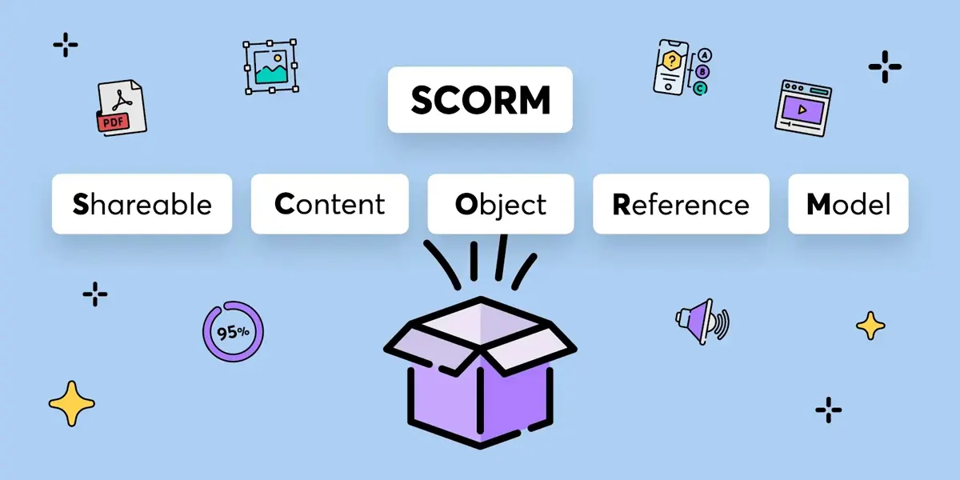
SCORM (Sharable Content Object Reference Model) is an international standard for online training content, developed by ADL (Advanced Distributed Learning – U.S. Department of Defense).
Its primary purpose is to ensure that ELearning courses can:
-
Work seamlessly across LMS platforms (Learning Management Systems).
-
Be packaged easily into standardized (.zip) files for deployment on any platform.
-
Track learner data such as progress, scores, learning time, and completion status.
In other words, SCORM is the “common language” that allows courses and LMSs to communicate effectively.
2. Why is SCORM Important in ELearning?
High Compatibility
SCORM courses can run on most popular LMSs (Moodle, Canvas, Blackboard, TalentLMS, SAP SuccessFactors…) without requiring significant adjustments.
Detailed Management & Tracking
SCORM enables systems to capture:
-
Learner progress within a course.
-
Percentage of content completed.
-
Scores, duration, and test results.
This allows enterprises to evaluate training effectiveness transparently and efficiently.
Reusability & Cost Savings
A SCORM course needs to be built only once but can be reused across different programs, branches, or LMSs—saving both time and costs.
Standardization & Scalability
By providing a unified standard, SCORM paves the way for smooth digital transformation in training, ensuring easy scalability as organizations grow.
3. Common SCORM Versions
SCORM 1.2
-
Released in 2001.
-
The most widely used version.
-
Simple, stable, and sufficient for basic tracking (progress, score, completion status).
SCORM 2004
-
Released in 2004 as an improvement over SCORM 1.2.
-
Allows sequencing (structured learning paths with prerequisites).
-
Provides more detailed reporting.
-
However, not all LMSs fully support its advanced features.
👉 For most enterprises, SCORM 1.2 remains the optimal choice due to its simplicity and widespread adoption.
4. Benefits of SCORM for Enterprises & Organizations
-
International Standardization: Ensures training content is compatible with global LMS platforms.
-
Enhanced HR Management: Track employee progress and learning outcomes.
-
Cost Efficiency: Build once, deploy multiple times.
-
Digital Transformation Support: Provides a strong foundation for sustainable, modern ELearning.
-
Better Learning Experience: Learners can study anytime, anywhere, on any device.
5. FAQ – Frequently Asked Questions about SCORM
1. What is SCORM used for?
→ SCORM ensures online courses are LMS-compatible and provides detailed learner tracking.
2. How does SCORM differ from xAPI or AICC?
-
SCORM: Popular, easy to implement, suitable for internal training.
-
xAPI (Tin Can API): Newer, more flexible, can track learning outside LMSs.
-
AICC: Older and now rarely used.
3. Which SCORM version should enterprises choose?
→ For most use cases, SCORM 1.2 is sufficient. For advanced tracking and structured learning paths, SCORM 2004 can be considered.
4. Is SCORM free to use?
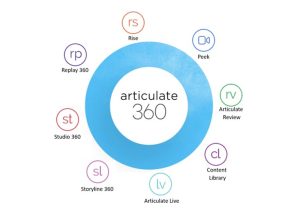
→ Yes. The SCORM standard is open and free to adopt. However, authoring tools (e.g., Articulate Storyline, iSpring, Adobe Captivate) are typically licensed products.
6. Conclusion
SCORM is the gold standard in ELearning, offering standardization, easy deployment, detailed tracking, and cost efficiency. For enterprises, adopting SCORM ensures effective internal training while enabling international integration and long-term scalability.
If your organization is implementing ELearning, prioritizing SCORM-based courses is the key to scalability, efficient management, and delivering optimal learning experiences for employees.